




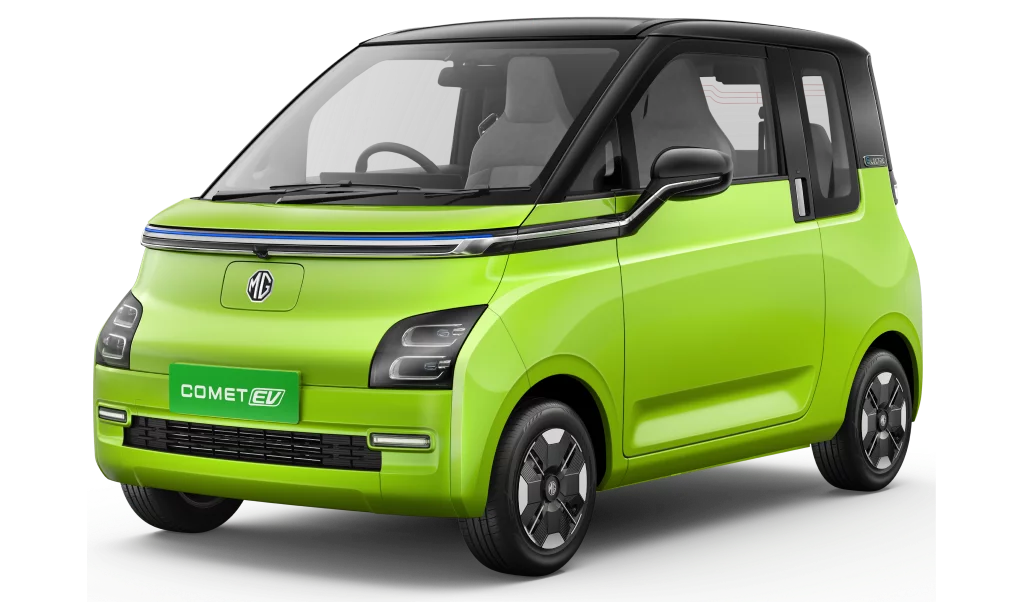
If your driving is mostly in the city—office runs, quick errands, school drops—the MG Comet EV is engineered around that use case. It is compact, easy to park, and designed to make EV ownership feel simple. Still, two buyer questions dominate: mg comet ev range (what you will realistically get) and mg comet safety rating (how to judge safety when you see mixed claims online).
Below is a practical, buyer-focused view: what MG officially states, what independent testing suggests, how to protect your everyday range, and how to interpret “rating” versus “features” for safety.
MG Comet EV Range: Claimed Versus Real Life
MG positions the Comet EV as a city-first EV with a 230 km range on a single charge, paired with a 17.3 kWh battery. That 230 km figure is the official headline, and MG highlights it on its product page as the “range that’s perfect for the city.”
However, certification numbers come from standardised test cycles. In daily traffic, your mg comet ev range will move up or down based on speed, AC usage, driving mode, and stop-and-go patterns.
Independent testing helps set expectations. Autocar India’s real-world range test reported an efficiency of 11.17 km/kWh, which extrapolated to roughly 193 km of range in their conditions, and they add that range will drop further in more aggressive driving modes.
A sensible way to plan is to treat 230 km as a best-case ceiling and budget for around 180–200 km for mixed city usage. If your daily run is 25–35 km, that can still mean multiple days between charges—one of the core strengths of a small, efficient city EV.
Charging: The Convenience Metric That Matters More Than Range
For a city EV, the charging routine often matters more than chasing the biggest range number. The Comet’s brochure lists estimated 0–100% AC charge times of about 7 hours (3.3 kW) and 3.5 hours (7.4 kW).
In practical terms, if you can plug in overnight at home, you start most mornings “full.” If you also have access to a workplace socket, your weekly charging becomes even easier. When charging is predictable, mg comet ev range feels less like a limit and more like a weekly budget you manage calmly.
How To Improve MG Comet EV Range In Real Driving
Range is largely an efficiency game. Guidance from Spinny aligns with what most EV owners experience: smoother driving, smarter regen use, and sensible climate settings make a visible difference.
The simplest playbook is consistency. Drive with a steady right foot rather than repeated hard launches; anticipate signals and slowdowns so regenerative braking can do more work; keep the cabin at a stable, comfortable temperature instead of running max cooling continuously; and maintain tyre pressure and alignment to avoid wasting energy on rolling resistance. These habits do not “hack” the car—they simply keep your mg comet ev range closer to what the powertrain can deliver in favourable conditions.
MG Comet Safety Rating: Rating Versus Equipment
Here is the key distinction: a safety rating is a score from standardised crash tests (such as Global NCAP or Bharat NCAP), while safety features are the systems and structure the car is equipped with.
As of the latest publicly available reporting, the MG Comet EV has not been officially tested by Global NCAP or Bharat NCAP, so there is no published NCAP star score to quote. That is why online answers on mg comet safety rating often sound vague—they are discussing equipment, not a formal rating outcome.
What MG Lists On Safety (And Why It Matters)
MG’s brochure and official site emphasise a safety-focused package built for urban use. The brochure calls out a high-strength body with 17 hot stamping panels and lists key safety systems including dual front airbags, ABS + EBD, Electronic Stability Control (ESC), hill hold control, electronic parking brake, rear parking camera, and tyre pressure monitoring.
MG’s website similarly highlights ABS + EBD, hill hold control, ESC, and strong-body messaging.
In real city driving, ESC and ABS + EBD help you stay in control during sudden braking or low-grip moments; the rear camera reduces low-speed incidents in tight parking and crowded lanes; and TPMS gives early warnings before a tyre issue becomes a handling issue. So if someone asks for mg comet safety rating, the accurate answer today is: there is no official NCAP star rating yet, but there is a published set of safety features you can evaluate systematically.
Battery Safety And Monsoon Practicality
EV safety is also about the battery and its protection. MG highlights an IP67-rated battery on its official page, and the brochure also describes it as a robust, water- and dust-resistant unit.
While IP67 is not a crash-test score, it is relevant for Indian conditions—rain, standing water patches, and daily exposure—because it signals resistance to dust and water ingress under defined standards.
Pricing Context: Standard Purchase And BaaS
Ownership structure can influence which variant you shortlist, and variant choice can affect convenience features such as charging capability.
In its 2025 brochure, MG lists ex-showroom pricing (for example, Executive at ₹7,49,800 and Blackstorm Edition at ₹9,99,800) and also provides Battery-as-a-Service (BaaS) pricing that reduces upfront costs (for example, Executive at ₹4,99,000 with a battery rental of ₹3.1/km).
MG’s official site also references the BaaS start price and per-km battery rental structure.
Final Take
If your priority is a practical urban EV, treat the MG Comet EV range as a planning tool, not a brag number. The certified headline is 230 km, while independent testing shows roughly 193 km in a real-world cycle; your own outcome will depend on driving style and conditions.
On the mg comet safety rating, separate the idea of a formal star score from the reality of safety equipment. Today, there is no published NCAP rating, but MG’s safety kit (ESC, ABS + EBD, hill hold, TPMS, rear camera, dual airbags, and a high-strength body focus) gives you tangible criteria to judge whether the Comet fits your risk expectations for city use.