




The discharge line is too hot to hold
Run a compressor for a few minutes, then carefully touch the metal line between the pump and the tank. It is hot enough to burn, and nothing inside it is burning. That heat is the unavoidable cost of forcing air into a smaller space, and on a gas powered air compressor working from the back of a service truck through a Canadian fall and winter, how the machine deals with it shapes nearly everything about its design.
Squeezing air makes heat, and heat makes the job harder
Compressing a gas raises its temperature, and hot air resists being compressed further. The more pressure a single cylinder tries to reach in one stroke, the hotter the air becomes and the more work the engine must do to finish the stroke.
That is why a single-stage pump starts to struggle as the target pressure climbs. Much of the energy going into the last part of the stroke ends up as heat rather than as stored air, and that heat also cooks the pump’s oil and valves.
Heat has a second effect that shows up later. Very hot air leaving the pump carries more oil vapor and moisture with it, and both drop out as the air cools in the tank and hoses, ending up in tools, paint lines and pneumatic valves downstream.
Why a 2 stage air compressor splits the work
A two-stage pump compresses air partway in a large cylinder, sends it through a finned tube where it cools, and then finishes the job in a smaller cylinder. Cooler air entering the second stage takes less work to compress to the final pressure.
The result is a pump that reaches high pressure, such as 175 PSI, with less wasted energy and cooler running temperatures than a single stage would manage. The higher pressure also gives the tank more stored air for the same volume.
The CFM figure only means something at a stated pressure
Delivery is rated in cubic feet per minute at a particular pressure, and the two numbers belong together. The same pump moves more air at a low pressure than at a high one, so a flow figure without its pressure tells very little.
Air tools publish their demand the same way. An impact wrench, a grinder or a sandblaster each needs a certain flow at its working pressure, and the compressor has to supply that continuously, not just when the tank is full. When a tool slows down after a minute of steady use, the tank has emptied faster than the pump can refill it. A 2 stage gas powered air compressor with a large tank keeps a deeper reserve at high pressure, so short bursts from demanding tools are covered while the pump catches up.
Hose matters here too. A long, narrow hose loses pressure along its length, so a tool at the end of a fifty-foot run can starve even when the gauge at the tank reads comfortably high. A shorter or larger hose often fixes a problem that looks like a weak compressor.
The engine keeps running while the pump rests
An electric compressor simply switches off when the tank is full. A gas engine cannot stop and restart that often, so these machines use an unloader that holds the intake valve open. The pump keeps turning without compressing, and the engine drops to a lower speed until pressure falls and work resumes.
That arrangement saves fuel and wear, but it means a running engine is not a sign that the pump is working. Watching the tank gauge, rather than listening to the engine, shows whether the machine is actually delivering air.
Cold mornings add a starting problem. A gas powered air compressor left on an open truck overnight in freezing weather has thick oil in both the engine and the pump, so starting it with the tank drained and the pump unloaded lets the engine warm before it has to push against pressure.
Mounting it on a truck is a structural decision
A truck mounted air compressor brings a heavy engine, a pump that vibrates with every stroke, and a sixty-gallon tank onto a bed that was designed to carry cargo. Before bolting it down, a few questions are worth answering:
- Will the bed floor carry the weight without flexing?
- Where will the exhaust go when the truck is parked?
- Can the pump sit close to level on typical sites?
- How far is the longest hose run from the truck?
Many reciprocating pumps are splash lubricated, flinging oil from a sump as the crankshaft turns, and working at a steep tilt can leave bearings dry. Parking the truck close to level on sloped job sites is part of keeping the pump alive. A gas powered air compressor for trucks should also be bolted through the bed with backing plates, since vibration loosens anything held only by thin sheet metal.
Exhaust is the hazard that does not announce itself
A gasoline engine produces carbon monoxide, which has no smell and no color. Running a compressor inside a closed truck cap, a garage or any enclosed space lets that gas build up to dangerous levels quickly.
The exhaust should point away from the cab, open doors and any work area where people spend time near the truck. In cold weather, when crews are tempted to close up the truck to keep warm, that rule matters most. A battery-powered carbon monoxide alarm in any enclosed truck body is inexpensive insurance.
Water is the winter problem
Compressed air carries moisture, and as it cools in the tank that moisture condenses into liquid water. In summer it rusts the tank slowly from the inside. In a Canadian winter it freezes, in the tank drain, in regulators and in air lines, and a frozen drain stops the water from ever leaving.
Opening the tank drain at the end of every working day, while the air is still warm and the water still liquid, prevents most of it. An inline water separator ahead of tools that dislike moisture adds another layer of protection.
The tank deserves the same attention as the pump. Water left inside for months corrodes the steel from the inside where nobody can see it, and a tank weakened that way is a pressure vessel with less margin than it started with. Pulling the ring on the safety valve now and then confirms it still opens, and a tank that shows rust weeping at a seam should be replaced rather than repaired.
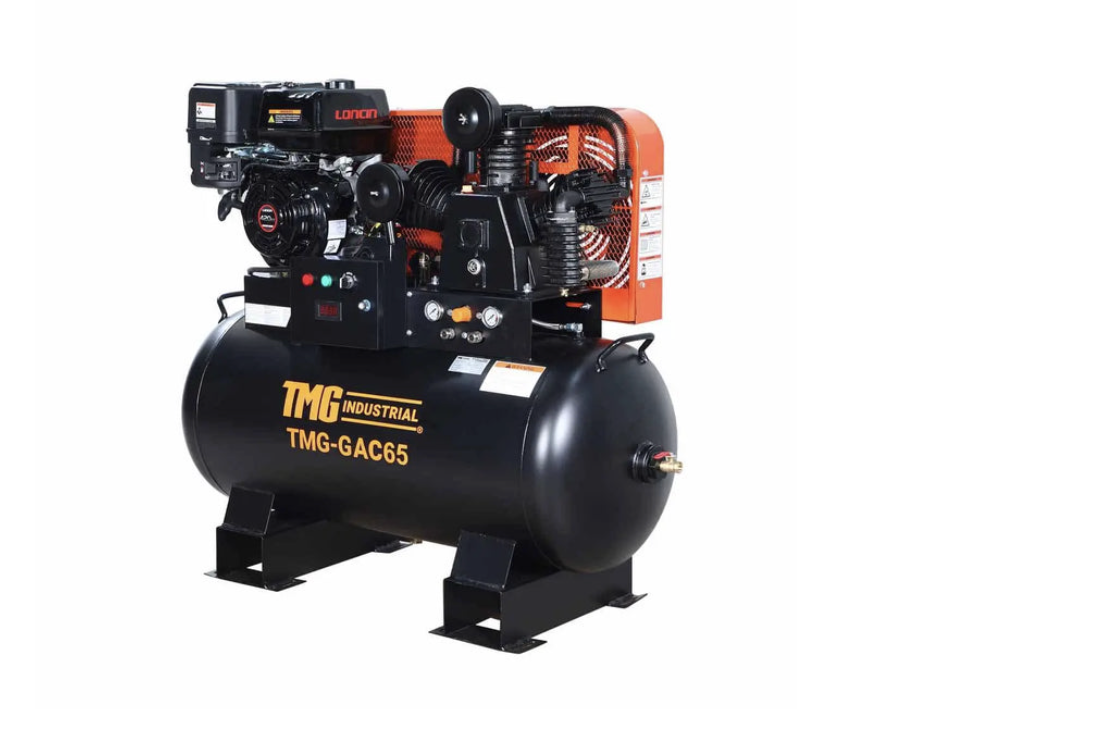
TMG Industrial pairs its skid-mounted unit with a Loncin gasoline engine and a horizontal sixty-gallon tank, and the habits that keep that kind of machine reliable are the same everywhere: drain daily, check the oil, keep it level, and keep its exhaust away from people.